Friday, December 30, 2011

Media Morsels - Year in Review
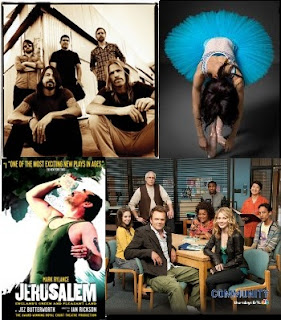

So, my dear readers, having experienced so much this year, I couldn’t narrow my list down to ten, so I went with 20. Here, in alphabetical order, are my picks for my favorite moments and experiences of 2011. Each is linked to my Tumblr page, which provides a fuller description of my experience.

  1. 50/50
  2. Award Moments, like Aaron Sorkin and Trent Reznor & Atticus Ross cleaning up during the season; Neil Patrick Harris rapping at the Tonys; and American Idiot winning a Grammy
  3. The Book of Mormon
  4. Community
  5. De Kooning: A Retrospective at the MoMA
  6. Fond Farewells, featuring Aaron Tveit, John Gallagher, Jr. and Michael Esper
  7. Foo Fighters, including Wasting Light, the Back and Forth documentary and their rocking performance as MSG
  8. Great Shows and Breakout Performances, starring Mark Rylance in Jerusalem, Nina Arianda in Venus in Fur and Jessie Mueller in On a Clear Day
  9. Make ‘em Laugh
  10. Muppets, both the movie and the Green Album
  11. New York = Marriage Equality
  12. New York City Ballet, particularly wonderful Wheeldon, For the Love of Duke and gorgeous photos
  13. New York Philharmonic plays West Side Story
  14. Now. Here. This.
  15. Summer of Love
  16. Tapping through Anything Goes
  17. Things to Ruin at le Poisson Rouge
  18. TV News, including the return of Arrested Development and Aaron Sorkin writing an HBO show that will feature John Gallagher, Jr.
  19. A War Horse and a Work Horse (hint: the work horse is Reed Birney)
  20. Wilfred

Tuesday, December 27, 2011

The Artist


Topping many critics’ year-end lists and gaining momentum as the pick for Oscar’s Best Picture of the Year is The Artist, a sweet and simple story from another era.

Well, it’s a modern film, but its gimmick is an homage to another era. The Artist is a black and white silent film. But I have to tell you, dear readers, it’s a great, entertaining film that is a testament to storytelling. As a writer, I’m usually all about the words and word choice. (That’s why I’m completely enamored of Aaron Sorkin’s writing.) But I’m also a ballet fan, and a fan of good storytelling, no matter the device. So it was a treat to watch a story unfold, and pick up plot points and nuances from the actors’ expressions and actions, the cinematography (Guillaume Schiffman) and the score (Ludovic Bource).

Set first in 1927, The Artist is more than slightly reminiscent of Singing in the Rain, another backstage movie about the advent of the talkies. However, The Artist, which follows its characters to 1932, focuses more on the titular artist, George Valentin (Jean Dujardin, a dashing mix of early Sean Connery and current George Clooney), a silent movie star who doesn’t adjust well to the new era filmmaking is entering. Intriguing him personally, at first, and then surpassing him professionally is Peppy Miller (the beautiful Berenice Bejo), a Millie-esque gal who rises to stardom as the talkies take over. (James Cromwell and a trimmer-than-usual-looking John Goodman also appear in pivotal supporting roles.)

Though it takes a couple of somber turns here and there, The Artist is mostly a delightful, feel-good film. I think what most critics and Hollywood insiders are responding to are the behind-the-scenes story and the craft of silent filmmaking. To be sure, beyond that, this film isn’t extraordinary. The story has little complexity and the performances are good but nothing of the breakthrough variety. Still, The Artist is a welcome antidote to much of the overproduced shlock that rely on pyrotechnics for thrills. (And it reminds of a time when people were famous because of their talent; as Ainsley Hayes once said, "It used to be you had to sing and dance.") It succeeds in spite of, or maybe because of, its simplicity, and writer and director Michel Hazanavicius is to be applauded for sticking to his vision and bringing such a classic form to modern audiences.

Sunday, December 25, 2011

Shame

In Shame, director Steve McQueen takes an intimate look at one man’s reaction to the shame that haunts him. Though we never find out what has caused Brandon (Michael Fassbender) or his sister, Sissy (Carey Mulligan), to be ashamed, it’s clear that it is shame that motivates them both toward untoward life choices.

Brandon is numb. He dresses in muted blues and grays, and the film is shot in thoroughly unexciting and unsaturated icey colors. (The only vibrant color in the film is that of blood. It may sound gory but it actually serves as a powerful juxtaposition to the drained, washed out look of everything else.) He has no emotional range; he’s either stoic or exploding. Nothing in between. Brandon is not a sensuous person. He doesn’t do anything for pleasure; he derives no pleasure from the sex to which he is addicted—it’s just a way to deal with the shame, and it’s a way of escaping emotion. In fact, during one almost-tryst, we see that emotion and connection are his kryptonite. And during another climactic scene, he looks hollow and scared.

McQueen and his co-writer, Abi Morgan, have come up with an interesting story, but what makes the film work and the way we know all of this about Brandon is an incredible and disturbingly seductive performance from Michael Fassbender. Fassbender (who looks like a cross between Ewan McGregor and Christian Bale) has been gaining buzz for a couple years now, and this is his coming out party. It’s really quite extraordinary that he was able to convey so much through a character that never lets his emotions show. Fassbender’s performance is raw and fearless, intriguing the audience despite Brandon’s actions.

Fassbender is joined on screen by Carey Mulligan, playing his younger sister. Sissy and Brandon have what I think is an atypical brother-sister relationship, but it works because the inappropriateness of some of their interactions are evidence of their shameful past. Sissy deals with the shame by being a free-spirit bohemian, flitting from place to place, eking out a living as a singer. The one time Brandon deigns to show emotion is when he hears Sissy sing at a nightclub. Mulligan has a sweet and fine movie voice, but it’s the emotion she packs into a slow and stripped version of the Sinatra classic “Theme from New York, New York” that moves Brandon, and just might haunt you for a few days.

Shame is an intimate film, not just with regard to the subject matter but also the way McQueen and cinematographer Sean Bobbitt shot it. Shame is filled with close up, tight shots, with many scenes playing out in one take. This makes us feel like we’re spying on the subjects. In one scene, Brandon and Sissy are having a confrontation. They’re sitting on Brandon’s couch, where he was idly watching some cartoon. The camera is behind them, so we see the back of their shoulders and their profiles when they turn to shout at one another. When Fassbender momentarily looked in the direction of the camera, I felt like should have ducked! It feels like we shouldn’t be watching—this is such a personal moment and we’re intruding.

All this combines for a fascinating character study. It’s raw and explicit, which is where the NC-17 rating comes in. (Although, you know how I feel about the MPAA. If the depiction of sex and the amount of nudity in this film had an equivalent depiction of violence and amount of gore in some action or war movie, this would have been rated R.) Shame isn’t going to be for everybody, but it’s an interesting and strangely compelling story, complete with a breakout performance from Michael Fassbender.

Bonus: Michael Fassbender talks about working on Shame.

Saturday, December 24, 2011

Cecil Beaton: The New York Years

If a picture is worth a thousand words, then Cecil Beaton spoke volumes. A consummate artist, Beaton had an eye for great aesthetic, whether he was presiding over a fashion photo shoot, drawing portraits, designing costumes for a Broadway show or simply shooting intimate photos of some of our most beloved, renown (and sometimes reclusive) celebrities.

Beaton’s work is currently on display at the Museum of the City of New York in its exhibit Cecil Beaton: The New York Years. The museum itself is a great little find, from its inviting front veranda to its cozy-mansion feel inside. Other current exhibits include The Greatest Grid (a look at Manhattan’s streets) and Kevin Roche: Architecture as Environment.

As described in the exhibit, Beaton was “an Edwardian-era dandy in the mold of Oscar Wilde. Beaton wore custom tailored suits and spoke in an exaggerated accent, announcing that he loved New York because it was so ‘egg-ill-ahh-rating!’”

Quite the character, Beaton’s worked spanned the artistic spectrum. As a painter, his portraits are striking. My friend and I both noted that the lines in his paintings are simple but the colors are extraordinary. Saturated, rich primary colors appear in blocks to punctuate his subject. (Subjects included Katharine Hepburn and Helen Hayes, the theatre legend for whom the theatre on west 44th street is now named.)

Though his portraits are very interesting, a large portion of his career was dedicated to fashion photography. For 40 years, Beaton shot for Vogue, developing a partnership with Edna Woolman Chase, Vogue’s editor in chief from 1914-1952. Of the art form, Beaton said, “fashion photography is an insidious profession. In art, it is what sex-appeal is to love.” Insidious though it may be, his photographs are captivating, and you can see his influence—all these years later—in fashion spreads in today’s magazines.

The part of Beaton’s career that I found most interesting was the years he spent in the performing arts. Beaton designed the costumes for Broadway’s My Fair Lady (and later the movie version), including those famous black and white costumes from the Ascot scene. Perhaps what I responded to most about Beaton’s designs in these years is his imagination. Referring to his designs for the Ascot scene, Beaton said, “Here, at last, was the opportunity to stage all the memories stored up since my early childhood.” Ah, to be able to express the imagination of a child—what a glorious opportunity.

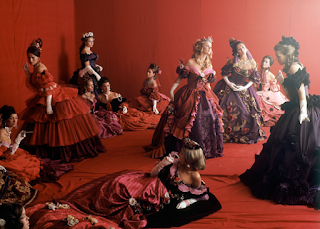
Beaton continued in the performing arts, designing for New York City Ballet and the Metropolitan Opera, in its inaugural season, no less. (See the dramatic red photo above.) He also continued taking photos, photographing everyone from Marilyn Monroe to Mick Jagger, Andy Warhol to Katharine Hepburn. His photographs, particularly of these luminaries, are so intimate—and iconic. Take the photo of Hepburn, at right. We’ve all seen this great photo before; now I know it was Cecil Beaton who took it!

As shown in the Museum of the City of New York’s enlightening exhibit, Cecil Beaton was a renaissance artist, and was able to capture exquisite moments in simple, everyday human life.


Cecil Beaton: The New York Years is on display at the Museum of the City of New York through February 20. Visit mcny.org for more information and to plan your trip.

Friday, December 23, 2011

Media Morsels 12.23.11

Dear Readers,
Please enjoy these last few Morsels of the year. Next week, Media Morsels will be dedicated to my Year in Review. Check back then to find out my favorite things of 2011.


Monday, December 19, 2011

Maple and Vine

We’re headed back to Pleasantville, dear readers. Although, much like in the Reese Witherspoon movie from the 90s, in Maple and Vine we see that the 50s, while they were perhaps a simpler time, what with the malteds and sock hops, they weren’t all we romanticize them to be.

Jordan Harrison’s new play, enjoying a run at Playwrights Horizons, focuses on Katha (Marin Ireland) and Ryu (Peter Kim), a married couple living in the present. But not for long. A stranger who looks plucked from the past, Dean (Trent Dawson), meets Katha in a park and before long, he and his wife, Ellen (Jeanine Serrales) have convinced Katha and Ryu to move to and join their Society of Dynamic Obsolescence (SDO), a custom-built community (think Celebration, Florida) in the Midwest in which it is perpetually 1955.

That’s right, 1955. The year never changes. Cell phones are prohibited, as are interesting or exotic flavors and foods like cumin, Portobello mushrooms and parmigiano-reggiano. Men wear the pants and the women iron them. They don’t know what Google is, who the Kardashians are or where there is a Starbucks. (Of course, because most of the adults in the SDO came from the real world, they are aware of such modern marvels, but, with the help of the Authenticity Committee, they live their lives as if these things did not exist.)

It’s an interesting premise, and the questions it raises and points it makes are thought provoking, though the play, directed by Anne Kauffman, loses steam and devolves into caricature silliness toward the end.

I can understand why someone might long for the 50s. Looking back at the era, many people think of it as a simpler time. Certainly, folks didn’t feel tethered to technology they way they do now. Living in this world of limitless possibilities can be overwhelming. In the play, when remembering life in the real world, one of the characters even comments, “We could have anything we wanted so we didn’t know what we wanted.” I’ve actually made a related argument with regard to an artist: that if you give an artist free reign, the first thing s/he’s going to do is ask for or create some boundaries. Otherwise you’re just staring at a blank canvas, not knowing where or how to begin. As Ellen puts it to Katha, when you join the SDO, you trade one kind of freedom for another. You learn to find freedom in the rigidity and limited choices.

So I get desire to hop in your DeLorean and go back to 1955. (Maybe not so coincidentally, 1955 is actually the year Marty and Doc travel back to in Back to the Future, Part One.) But the thing is, the SDO isn’t all it’s cracked up to be. Which is one of the reasons I liked Alexander Dodge’s scenic design. In present day, the backdrops were made to look like rain, as if 2011 has only rainy days and gloom. When we enter the SDO, the “1955” homes are adorned with bright, sunny and (nauseatingly) cheery wall paper, suggesting that bad things don’t happen in 1955. Of course, these backdrops were both juxtaposed with what was actually happening in people’s lives. There was some happiness in 2011 and there is plenty of clouds and gray in 1955.

Moreover, when Dean and Ellen make their pitch, even before Ryu expressed this to Katha, I thought it sounded like a cult. The SDO has its own gated community with its own set of rules and way of life. Newcomers have to be indoctrinated into the mores of the SDO and forget their “old lives.” And, much like a cult might do, Dean and Ellen seemed to prey on hapless humans. After a miscarriage, Katha and Ryu’s faith has been shaken; life is getting rough or even unbearable, so Dean and Ellen give them something to believe in, something to give their lives structure and meaning. The whole thing is more than a little creepy.

Sure, life before gourmet home cooking might have been simpler, and it seems like giving up a spice here or a computer there is not a big deal, but that myopic worldview of 1955 extends to human interaction. Racism is still prevalent in the SDO, as it would have been in 1955, and gay people stay in the closet. Women don’t work but rather spend seven hours a day trying to perfectly execute a chicken stock recipe. And even though no one has “heard” of Facebook, everyone knows everyone’s business because a good neighbor lends a caring ear (and later a blabbering mouth).

I’m glad that Harrison’s play depicts both sides of 1955, but I’m disappointed in the characters’ decisions to allow themselves to be tamed and censored. As modern human beings, we should know better. We should know that we can make the choice to set down the Crackberry and unplug; women can make the choice to stay home and not work a paying job. We don’t need give up modern-day conveniences and the freedoms inherent in the 21st century to lead a full and fulfilling life. Like Billy Joel once sang, “The good old days weren’t always good, and tomorrow aint as bad as it seems.”

Friday, December 16, 2011

Media Morsels 12.16.11

Thursday, December 15, 2011

Golden Globe Nominations

The Golden Globes, which honor both film and television, will be handed out on Sunday, January 15, 2012, and cheeky funny man Ricky Gervais will once again be hosting the ceremony. (Remember that the Globes are administered by the Hollywood Foreign Press Association (HFPA), which is comprised of all sorts of foreign press, including tabloid rags.)

Here are some of the nominees. I’m very pleased to see that 50/50 and Drive (and both films’ actors) got some love; Ryan Gosling is nominated twice this year (as is Kate Winslet); Aaron Sorkin is a nominee; and Chris Cornell, Soundgarden’s frontman, is nominated for Best Original Song (for “The Keeper” from Machine Gun Preacher). On the TV front, there aren’t too many surprises, though I do, of course, have my favorites.

Film

Best Picture, DramaBest Picture, Comedy or Musical
  • 50/50
  • The Artist
  • Bridesmaids
  • Midnight in Paris
  • My Week with Marilyn

    I'm surprised by the classification of some movies as dramas and others as comedies. Obviously, The Ides of March is a drama and obviously Bridesmaids is a comedy (even though I didn't think it was funny). But from everything I've read and all the clips I've seen of My Week with Marilyn, I thought it would be in the drama category. And Moneyball had plenty of funny moments while 50/50 had tons of pathos. Oh well. At least having both categories allows for a broader range of films to be nominated.
Best Actress (drama)
  • Glenn Close, Albert Nobbs
  • Viola Davis, The Help
  • Rooney Mara, The Girl with the Dragon Tattoo
  • Meryl Streep, The Iron Lady
  • Tilda Swinton, We Need to Talk about Kevin
Best Actor (drama)
  • George Clooney, The Descendants
  • Leonardo DiCaprio, J. Edgar
  • Michael Fassbender, Shame
  • Ryan Gosling, The Ides of March
  • Brad Pitt, Moneyball

    I've already seen three of the five nominees, and by the end of the month, I will have seen the other two. Of course, I'm always rooting for Leo, but Gosling and Pitt were exceptional in their films, and I hear that Clooney and Fassbender are also pretty tough competition. This is one talented (and handsome!) group of nominees. Also, it's interesting to note that this now pits Gosling against his director, Clooney.
Best Actress (comedy)
  • Jodie Foster, Carnage
  • Charlize Theron, Young Adult
  • Kristen Wiig, Bridesmaids
  • Michelle Williams, My Week with Marilyn
  • Kate Winslet, Carnage

    From this group, I've only seen Wiig's performance, which was fine. But, I know Carnage from when it was God of Carnage and playing on Broadway; so I know the roles and both are great. Seeing as the talented Foster and Winslet are playing the parts, my guess is that these nominations are well deserved.
Best Actor (comedy)
  • Jean Dujardin, The Artist
  • Brendan Gleeson, The Guard
  • Joseph Gordon-Levitt, 50/50
  • Ryan Gosling, Crazy, Stupid, Love
  • Owen Wilson, Midnight in Paris

    Yay! Joseph Gordon-Levitt was nominated. He was nominated in this category two years ago for (500) Days of Summer. He was terrific in 50/50, and I'm really glad he's being recognized for it. I'm also glad that Ryan Gosling's abs are being recognized for their performance in Crazy, Stupid, Love.
Best Supporting Actress
  • Berenice Bejo, The Artist
  • Jessica Chastain, The Help
  • Janet McTeer, Albert Nobbs
  • Octavia Spencer, The Help
  • Shailene Woodley, The Descendants
Best Supporting Actor
  • Kenneth Branagh, My Week with Marilyn
  • Albert Brooks, Drive
  • Jonah Hill, Moneyball
  • Viggo Mortensen, A Dangerous Method
  • Christopher Plummer, Beginners

    I just watched Beginners last night and loved it, so I'm glad to see Plummer is nominated. I'm most excited, however, about Albert Brooks's nomination for his against-type character in Drive.
Best Director
  • Woody Allen, Midnight in Paris
  • George Clooney, The Ides of March
  • Michel Hazanavicius, The Artist
  • Alexander Payne, The Descendants
  • Martin Scorsese, Hugo

    Having only seen The Ides of March thus far, I don't really have a favorite, but I'm really curious to see what the prolific Scorsese did with first foray into 3-D film making.
Best Screenplay
  • Woody Allen, Midnight in Paris
  • George Clooney, Grant Heslov and Beau Wilimon, The Ides of March
  • Michel Hazanavicius, The Artist
  • Alexander Payne, Nat Faxon and Jim Rash, The Descendants
  • Steven Zaillian and Aaron Sorkin, Moneyball

    You know how I feel about Aaron Sorkin, dear readers, but since I haven't seen all of the nominated films, I can't objectively say that Sorkin and Zaillian should win. I plan on seeing all these before the Globes are handed out, so check back in.

Television


Best Series, Drama
  • American Horror Story
  • Boardwalk Empire
  • Boss
  • Game of Thrones
  • Homeland

    What’s interesting about this category is that all the shows are on cable, with all but American Horror Story on premium cable channels. The big three networks need to step up their game!
Best Series, Comedy or Musical
  • Enlightened
  • Episodes
  • Glee
  • Modern Family
  • New Girl

    New Girl? Really? That show is bad. Can I please exchange New Girl's nomination for some Community love?!? I’m glad that both Modern Family and Episodes were nominated, though. (I’m still deciding whether or not I like Enlightened. I’m about five episodes in, and I’m leaning toward “I like it.”)
Best Actress (drama)
  • Claire Danes, Homeland
  • Mirelle Enos, The Killing
  • Julianna Margulies, The Good Wife
  • Madeline Stowe, Revenge
  • Callie Thorne, Necessary Roughness
Best Actor (drama)
  • Steve Buscemi, Boardwalk Empire
  • Bryan Cranston, Breaking Bad
  • Kelsey Grammer, Boss
  • Jeremy Irons, The Borgias
  • Damian Lewis, Homeland
Best Actress (comedy)
  • Laura Dern, Enlightened
  • Zooey Deschanel, New Girl
  • Tina Fey, 30 Rock
  • Laura Linney, The Big C
  • Amy Poehler, Parks and Recreation

    I like of the nominees except for Deschanel. Let me be more specific: I don't like her character or performance on New Girl. I've watched Deschanel in plenty of movies and have liked her just fine. (Example: Our Idiot Brother) I don't know who I'd nominate in her place (since the Modern Family folks are in the supporting category), but I really don't think a performance that says, "Look at how cute I can be" deserves a nomination.
Best Actor (comedy)
  • Alec Baldwin, 30 Rock
  • David Duchovny, Californication
  • Johnny Galecki, The Big Bang Theory
  • Thomas Jane, Hung
  • Matt LeBlanc, Episodes

    This seems like such a mixed bag, and I guess I'm a little surprised that Steve Carell wasn't nominated for his final season of The Office, but really - no complaints.
Best Supporting Actress (series, mini-series, etc.)
  • Jessica Lange, American Horror Story
  • Kelly MacDonald, Boardwalk Empire
  • Maggie Smith, Downton Abbey
  • Sofia Vergara, Modern Family
  • Evan Rachel Wood, Mildred Pierce

    I really don't like the way drama, comedy and mini-series are combined into this one category because trying to compare what Sofia Vergara does on Modern Family to what Kelly MacDonald does on Boardwalk Empire to what Evan Rachel Wood did in Mildred Pierce is like comparing apples to a chalkboard, but that's the way the Globes go...
Best Supporting Actor
  • Peter Dinklage, Game of Thrones
  • Paul Giamatti, Too Big to Fail
  • Guy Pearce, Mildred Pierce
  • Tim Robbins, Cinema Verite
  • Eric Stonestreet, Modern Family
Best Mini-Series, etc.
  • Cinema Verite
  • Downton Abbey
  • The Hour
  • Mildred Pierce
Best Actress, Mini-Series, etc.
  • Romola Garai, The Hour
  • Diane Lane, Cinema Verite
  • Elizabeth McGovern, Downton Abbey
  • Emily Watson, Appropriate Adult
  • Kate Winslet, Mildred Pierce
Best Actor, Mini-Series, etc.
  • Hugh Bonneville, Downton Abbey
  • Idris Elba, Luther
  • William Hurt, Too Big to Fail
  • Bill Nighy, Page Eight
  • Dominic West, The Hour

So there you have it, the Golden Globe nominees. (Some of them.) HBO leads the pack with 18 nominations, while The Artist is the most nominated film (six nominations). Tune into NBC on January 15 to see who wins (and what everyone’s wearing!)

View the full list of nominees at goldenglobes.org.

Wednesday, December 14, 2011

Lysistrata Jones

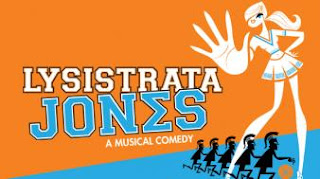
Some shows open your mind, touch your heart and move the public discourse forward. (Recent examples: American Idiot and Jerusalem.) These shows do what artists have been doing for thousands of years, since Thespis stepped on stage at the Theatre Dionysus in 534 BC. Other shows are just fun fluff. Lysistrata Jones, though it has roots in ancient Athens, is simply fun fluff.

Based on the Aristophanes play Lysistrata (which, as they point out in the new musical, is public domain), Lysistrata Jones tells of a group of young women, organized by Lyssie J. herself, who refuse to “give it up” until their boyfriends, making up Athens University’s basketball team, win a game, ending a 30-year losing streak. (In the Aristophanes work, Lysistrata, whose name means "disband the army," and company go on a sex strike until their men negotiate a treaty to end the war. When it was written in 411 BC, Athens had been at war for over 20 years. The natives were getting restless.)

While scholars have argued that in Lysistrata there is much to consider regarding women’s sexual power, and if their power can ever be considered without factoring in sexuality, that’s not what Lysistrata Jones is about. (If you’re looking for an amazing sexual power play, go see Venus in Fur.) Instead, it’s about a spunky cast bopping around to original pop tunes while playing basketball. And that’s okay. Sometimes, a show, movie, song or something else is just meant to be fun. Not everything has to be heavy or complex. (True, I tend to prefer the complex, smart and though-provoking works, but I concede that there’s room for the other.)

Playwright Douglas Carter Beane (Mr. and Mrs. Fitch) partnered with his partner, Lewis Flinn, to adapt Aristophanes’s classic play for modern times. Beane takes care of the book while Flinn handles the score. The book is funny, if a bit scattered. (There are jokes about both Amelia Earhart and iPhones.) And the songs are original, which is a noteworthy feat in and of itself. One problem with the score – and it’s really more a problem with its execution combined with the fact that this is a new show – is that I had trouble deciphering many of the lyrics, especially in up-tempo, choral songs. Mind you, you don’t miss the gist, just specific lyrics here and there.

As directed and choreographed (sometimes in a repetitive manner) by Dan Knechtges, the cast is perky and eager to please. Patti Murin leads the company as Lyssie, with Josh Segarra, Jason Tam, Lindsay Nicole Chambers and Liz Mikel, among others, appearing as featured players. Everyone was good, but no one was great. Especially for a Broadway show. It is evident that everyone on stage has talent. Murin has a nice voice and Mikel brings lots of sass to her songs. But, as a colleague of mine observed, it seemed like this cast represented the best the producers could find in Dallas, where the show was originally presented. It doesn’t represent the best the producers might find if they looked to recast for Broadway. (And they must know it, because in an attempt to add more oomph to most musical numbers, conductor Brad Simmons and vocalist/percussionist Biti Strauchn sing along, providing a vocal assist.)

Lysistrata Jones had a well-received off-Broadway run here in New York last season. It played at The Gym at Judson, making it a terrifically site-specific show. I think this scrappy, original musical could have had a long life off-Broadway, but I understand the producers’ desire to move it to Broadway. Broadway means Lysistrata Jones will be easier to license to schools and for touring and regional/community purposes. And so it goes that Lyssie Jones is on Broadway. It’s fun and entertaining, but not much more.

To learn more about Lysistrata Jones, visit lysistratajones.com.

(Production stills, by Carol Rosegg, from Broadwayworld.com)

SAG Award Nominations


The 18th annual SAG awards, which honor both film and television, will be handed out on Sunday, January 29, 2012.

Here are some of the nominees, along with my commentary. Of course, as it’s a little early on in the award season I haven’t seen many of nominated films or performances, but several of them are on my list so I’ll let you know when I do!

Film:
  • Outstanding Ensemble
    • The Artist
    • Bridesmaids
    • The Descendants
    • The Help
    • Midnight in Paris
    Having only seen Bridesmaids, I can’t fairly choose a favorite. Although I didn’t like Bridesmaids – I didn’t find it nearly as funny as everyone else did – I think the ensemble of funny ladies did work well together. I’m planning on seeing The Artist and The Descendants before the end of the month; check back for reviews!
  • Outstanding Actress
    • Glenn Close, Albert Nobbs
    • Viola Davis, The Help
    • Meryl Streep, The Iron Lady
    • Tilda Swinton, We Need to Talk About Kevin
    • Michelle Williams, My Week with Marilyn

  • Outstanding Actor
    • Demian Bichir, A Better Life
    • George Clooney, The Descendants
    • Leonardo DiCaprio, J. Edgar
    • Jean Dujardin, The Artist
    • Brad Pitt, Moneyball
    Obviously I’m rooting for my favorite actor, Leo, but I haven’t seen Bichir, Clooney or Dujardin.

  • Outstanding Supporting Actress
    • Berenice Bejo, The Artist
    • Jessica Chastain, The Help
    • Melissa McCarthy, Bridesmaids
    • Janet McTeer, Albert Nobbs
    • Octavia Spencer, The Help

  • Outstanding Supporting Actor
    • Kenneth Branagh, My Week with Marilyn
    • Armie Hammer, J. Edgar
    • Jonah Hill, Moneyball
    • Nick Nolte, Warrior
    • Christopher Plummer, Beginners
    At the moment, I’m rooting for Hammer, but Beginners just arrived (via Netflix) so I may end up updating my choice!
Television
  • Outstanding Ensemble, Comedy
    • 30 Rock
    • the Big Bang Theory
    • Glee
    • Modern Family
    • The Office
    I really wish Community or the deep bench of Parks and Recreation would have received a nomination. I’d easily let go of Glee or The Office for either or both of those. I think Community and PRex could have given Modern Family a run for its money; as the nominees stand, this award belongs to Modern Family.

  • Outstanding Ensemble, Drama
    • Boardwalk Empire
    • Breaking Bad
    • Dexter
    • Game of Thrones
    • The Good Wife
    Of the nominees, I only watch Boardwalk and The Good Wife, and of those, I’m rooting for Boardwalk. They have an incredible ensemble bringing some very colorful characters to life.

  • Outstanding Actress (drama)
    • Kathy Bates, Harry’s Law
    • Glenn Close, Damages
    • Jessica Lange, American Horror Story
    • Julianna Margulies, The Good Wife
    • Kyra Sedgwick, The Closer

  • Outstanding Actor (drama)
    • Patrick J. Adams, Suits
    • Steve Buscemi, Boardwalk Empire
    • Kyle Chandler, Friday Night Lights
    • Bryan Cranston, Breaking Bad
    • Michael C. Hall, Dexter
    I’m super surprised to see Adams on here because the show it awful. I watched the first few episodes and had to stop in order to remain sane.

  • Outstanding Actress (comedy)
    • Julie Bowen, Modern Family
    • Edie Falco, Nurse Jackie
    • Tina Fey, 30 Rock
    • Sofia Vergara, Modern Family
    • Betty White, Hot in Cleveland
    What a great category! I don’t watch Cleveland, but who doesn’t love Betty White? And the other four ladies are excellent at what they do. Just because so many people in the “biz” love Fey, I give her the edge, but I will be happy with any winner in this category.

  • Outstanding Actor (comedy)
    • Alec Baldwin, 30 Rock
    • Ty Burrell, Modern Family
    • Steve Carell, The Office
    • Jon Cryer, Two and a Half Men
    • Eric Stonestreet, Modern Family
    I think Steve Carell is a sentimental nomination—which is fine; I’d just like to see Burrell or Stonestreet win.

  • Outstanding Actress in a TV Movie or Miniseries
    • Diane Lane, Cinema Verite
    • Maggie Smith, Downton Abbey
    • Emily Watson, Appropriate Adult
    • Betty White, The Lost Valentine
    • Kate Winslet, Mildred Pierce
    For this (and the next category) my money is on the Emmy winners: Winslet and Pearce.

  • Outstanding Actor in a TV Movie or Miniseries
    • Laurence Fishburne, Thurgood
    • Paul Giamatti, Too Big to Fail
    • Greg Kinnear, The Kennedys
    • Guy Pearce, Mildred Pierce
    • James Woods, Too Big to Fail
And those are the SAG Award nominees. Tune into TBS or TNT on January 29 to see who wins and which stars will introduce themselves as actors at the top of the show. View the full list of nominees at sagawards.org.

Sunday, December 11, 2011

On a Clear Day You Can See Forever

Having seen the lab production of On a Clear Day You Can See Forever at the Vineyard Theatre over the summer, I went into the St James Theatre ready to swoon over the Broadway iteration. And boy, did I.

It began when I took my seat and caught a first glimpse at Tony Award winner Christine Jones’s scenic design. (Most the design team, including Jones and lighting designer Kevin Adams, have worked with director Michael Mayer on either Spring Awakening or American Idiot, or both.) Just by looking at the “curtain,” I knew this was a great design. It’s total 70s, op-art, meant to be trippy and maybe a bit disorienting. (This is perfect for a show about hypnosis and regressions.) Once the show began, I could see that Adams’s lighting design so perfectly complemented the scenic design. The psychedelic colors kept changing and twisting into groovy swirls. Throughout the show, the seamlessly matched designs continue the theme of uncertainty, with the “backdrops” crossing in and out, so nothing was as it seems.

And the swooning continued when the talented cast did their thing. There are wonderful voices singing this lush and lovely score by Burton Lane and Alan Jay Lerner. Director Mayer really knows how to assemble an incredible array of voices.

(Before swooning over the cast, a moment to explain the story: Dr. Mark Bruckner (Harry Connick, Jr.) is a psychiatrist who takes on new patient, David Gamble (David Turner). Gamble wants to quit smoking, so he asks Bruckner to hypnotize him. Bruckner obliges but while Gamble is under hypnosis, Bruckner discovers Melinda (Jessie Mueller), a 40s jazz singer brought out in Gamble’s regression. (The show is set in 1974.) Bruckner starts falling for Melinda, which is confusing for Gamble and his boyfriend, Warren (Drew Gehling). Don’t worry if this sounds confusing to you, too. It’s all very clear in the show. Or, let Michael Mayer explain it: "David falls in love with Mark, a man who's unavailable because he's heterosexual. Mark falls in love with Melinda, but he can't have her because, well, she's dead. Now that's a love triangle!")

David Turner, who was recently seen in Arcadia, is buoyant and endearingly goofy as the highly suggestible Davey Gamble. Featured members Sarah Stiles (as spunky best friend Muriel), Drew Gehling (impressive as the forlorn boyfriend Warren), and ensemble members like the sassy American Idiot alumna Alysha Umpress and the perky Catch Me if You Can alumna Alex Ellis are having a ball bringing this story to life, especially when “On the S.S. Bernard Cohn.”

Truth be told, I found the weakest link in the cast to be the marquee draw: Harry Connick, Jr. He has a great voice – there’s no denying that. But he was disappointingly and thoroughly uncharismatic on stage. Moreover, he dreadfully lacked chemistry with his co-stars, male and female. While watching him look uncomfortable singing on stage (he appears to need to hold his body in a very specific way in order to get out the right notes), I longed for the smooth charm of Marc Kudisch, who played the role at the Vineyard. I saw On a Clear Day twice in previews and Connick improved slightly. It seems he has the acting part down and he has the singing down; he just can't do them together.

But not to worry, because there is most definitely a swoon-worthy, star-turn performance in this show, and it comes by way of Broadway newcomer Jessie Mueller. Mueller is sultry and smooth and beautiful. Her gorgeous, velvety voice is incredible. In the show, her character talks about finding meaning in the words. Mueller finds meaning the notes. Truly, she’s sensational. The thing that separates her from most of the other female vocalists on the boards these days is soul. Mueller most definitely has it!

And, finally, a great big swoon for visionary director Michael Mayer. Along with book writer Peter Parnell, Mayer re-imagines this nutty tale. In Mayer’s more than capable hands, this is practically a new musical. (Is he worried about what traditionalist might think? Nah. He says, "Since the first time somebody set a Shakespeare play in a period other than 16th-century England, other people's work has been reinterpreted.") Even though the show is set 37 years in the past, with dalliances even farther back in time, this feels totally modern and fresh. Mayer has taken a lovely score, updated the book and created a beautiful musical that had me smiling the entire time.

This is the first must-see musical of the season, a true delight that is not to be missed.

For more information about On a Clear Day You Can See Forever and to purchase tickets, visit onacleardaybroadway.com. (Be sure to check out the "press" section for lots of great bonus material.)

Bonus: