Posts

Showing posts with the label Ashly Isaacs

The Sleeping Beauty

Image
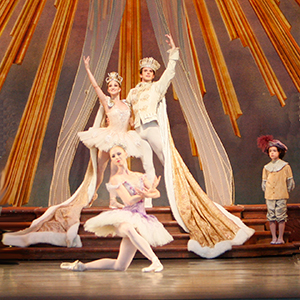
I tend not to like narrative ballets (especially full-length narratives) because I find there's not enough dancing. Sure, there's usually a nice pas de deux, but usually it's just a lot of graceful gesturing. So I was pleasantly surprised that Peter Martins 's take on The Sleeping Beauty includes quite a bit of dancing, much more than I expected. I guess that when the main plot points of a story revolve around parties and dreamy visions, there's plenty of opportunities for divertissements and fantasy dances. The libretto (by Marius Petipa and A. Vsevolozhsky )for this version hews pretty closely to what most people know (likely from the Disney animated film). We begin at the palace where the king ( Andrew Scordato ) and queen ( Gretchen Smith ) are celebrating the arrival of their daughter, Princess Aurora. The Catalabutte ( Sean Suozzi ) and his lackey ( Giovanni Villalobos ) provide a welcome amount of humor. Soon, various fairies are bestowing blessings up...
NYCB: New Combinations

Image
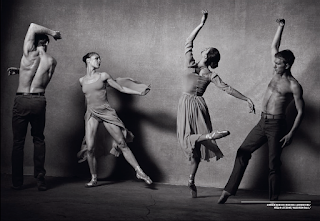
Notes on the New Combinations evening, including the world premiere of two ballets: Fearful Symmetries : This Peter Martins ballet is reminiscent of Robbins's Glass Pieces , though it's just one movement (with a coda). Using the John Adams composition of the same name, Fearful Symmetries , which I first saw in 2011 , is athletic and buoyant. Taking its cue from the music, there is repetition—symmetry—to the steps. The ending coda is like a cool down, something suggesting that everything leading up to it was a fever dream. There are no principals, giving more corps de ballet members and soloists an opportunity to be showcased, and not just the two main couples ( Claire Kretzchmar + Russell Janzen and Ashly Isaacs + Zachary Catazaro ). In particular, I noticed featured soloist Harrison Ball , who made great leaps in some impressive sections. While Isaacs comes on like a seductress, Kretzchmar looks too green to make me believe she feels anything the ballet might be ...

NYCB: 21st Century Choreographers

Image
Notes on the 21st Century Choreographers program: (This program was supposed to include the new ballet by Annabelle Lopez Ochoa, Unframed , which debuted at the NYCB fall gala. As occasionally happens, the program was changed, and instead of Unframed , we saw the After the Rain  pas de deux.) For Clara : This marks principal dancer Lauren Lovette 's choreographic debut with the Company, making her one of the few women to have choreographed for the New York City Ballet. (Lovette choreographed when she was a student, but not since joining the Company.) Lovette uses "Introduction and Concert-Allegro, Op. 134" by Robert Schumann , and has said that the title of her ballet is an homage to Schumann's wife, Clara. As this was created for the fall gala, which, for several years, has seen the fusion of fashion and ballet, fashion designer Narciso Rodriguez designed the costumes (so you can thank him for dressing Zachary Catazaro in nothing by tight dance pants). Lov...

NYCB: Bournonville Divertissments; Moves; Tschai Pas; and Symphony in Three Movements

Image
New York City Ballet is back in full swing. For the first of my five ballet outings this spring, I got to see four ballets, three of which I hadn't seen in at least two years. We began with Bournonville Divertissements , which was paired with La Sylphide last spring . These are selections from August Bournonville 's repertoire, and feature music by Holger Simon Paulli and Edvard Helsted. (Based on Bournonville's choreography, Bournonville Divertissements was originally stage by Stanley Williams; it was later staged for NYCB by Nilas Martins.) As divertissements should be, all four movements are presentational, mostly meant to be pretty and pleasant and fun. The first movement is "Ballabile," led by Erica Periera and Troy Schumacher , and it's the most presentational of all. From my view, it actually looked a little sloppy, and like the men were having trouble partnering with the women. Of course, that's part of the choreography (all I had to do ...

City Ballet: Harlequinade and NY Export: Opus Jazz

Image
The New York City Ballet fall season has come to a close, but before it did, I got to see works by founding choreographers George Balanchine and Jerome Robbins. First was George Balanchine 's two-act narrative ballet, Harlequinade . I tend to shy away from narrative ballets, as most of them have a lot of graceful gesturing and not a lot of dancing. I was pleasantly surprised, however, by the wealth of actual dancing in Harlequinade , which is Balanchine's tribute to Marius Petipa's Les Millions d'Harlequin and features a host of commedia dell'arte characters. (The ballet is set to Riccardo Drigo 's music, which he composed for Petipa's ballet.) The story is fairly simple. Columbine ( Ashley Bouder ) and Harlequin ( Andrew Veyette ) are in love but Columbine's father, Cassandre ( Giovanni Villalobos ), disapproves. He hires a few stooges to get rid of Harlequin, while bringing in Leandre ( Aaron Sanz ), his wealthy choice of suitor. Meanwhile, ...

City Ballet: Raymonda Variations; Morgen; and NY Export: Opus Jazz

Image
My final ballet outing of the 2014-2015 season was a mixed repertory program that included my favorite, NY Export: Opus Jazz . But before that Jerome Robbins classic were works by Mr. B and Peter Martins. First up was George Balanchine's Raymonda Variations . In the program notes, Balanchine is quoted as saying the Alexander Glazounov score for the three-act Raymonda  ballet is "some of the finest ballet music we have," and Mr. B's adoration of the music shows in his choreography. In Balanchine's plotless ballet (having nothing to do with the original ballet), we are treated to, as the title suggests, variations on a theme. The piece begins with the curtain down and the orchestra playing the musical theme, an overture for the ballet, if you will. Once the curtain rises, the ensemble (all women) enter for a pretty group dance, and then soloist Erica Pereira and principal Andrew Veyette perform a nice pas de deux. Then come the nine variations, all bri...